
Introduction
This week on Unicorn Exploration, Maura and I were talking about lower grade Archean gold deposits. One thing that came up was the application of ore sorting and how that helps to change the economics of some deposits. Today I will go over ore sorting, a technology that can effectively increase the grade of a mineral deposit!
What is ore sorting?
Ore sorting is the application of technology to separate run-of-mine material into fractions prior to putting it through any other processing. It is also called dry sorting because it usually occurs prior to material entering the mill and getting wet. It uses some kind of sensor to detect whether or not a given grain meets some threshold, and then separates it based on that.
Ore sorting is a type of filter
In other words, it is a filter that acts on natural materials. Geology is full of these, although they take many forms:
- resource definition
- mine design
- grade control
- flotation and gravity sorting
- gold panning
Some filters are physical (such as flotation, coffee filters, etc.) and others are more conceptual (resource classification, cutoff grades). In fact, we can generalize many things we do in exploration and mining as filters of this kind. Perhaps we can explore that idea a bit more and see what we can learn from the world of filters. But for now, I’ll stick to what inspired this post.
Why do we sort ore?
Ore sorting offers a way of enriching the mined material after it has been mined. It could also allow the separation based on metallurgical characteristics too. It increases the grade of the run of mine or the head grade before it reaches more expensive, carefully tuned parts of the process.
How does it work?
At its heart, an ore sorting system consists of a sensor and an actor. There are many kinds of sensor, including:
- X-ray transmission (XRT)
- X-ray fluorescence (XRF)
- X-ray diffraction (XRD)
- Optical
- Laser
- Near infrared (NIR)
XRT is by far the most common and is usually what people mean by ore sorting.
The actor is a lot simpler. It’s usually something called an air jig. A jig is a device that uses compressed air to push material out of a stream such as a conveyor belt. An air jig is actually a modern version of an ancient mining technology that uses pulses of some kind of fluid (usually water) to separate material based on density. The first jigs were baskets! Much more jig content can be found here.
Here is a picture from Agricola’s De re metallica showing the relatively new (in the 1500s) invention:


They haven’t changed all that much, although the people have been replaced with machines for the most part and the fluid might not always be water.
Ore sensing
Like all geophysical methods, the sensor relies on some kind of contrast between good and bad material. In order to use it, automation is required to process the data and emit the right signal fast enough. It’s different for each method.
XRT (density)

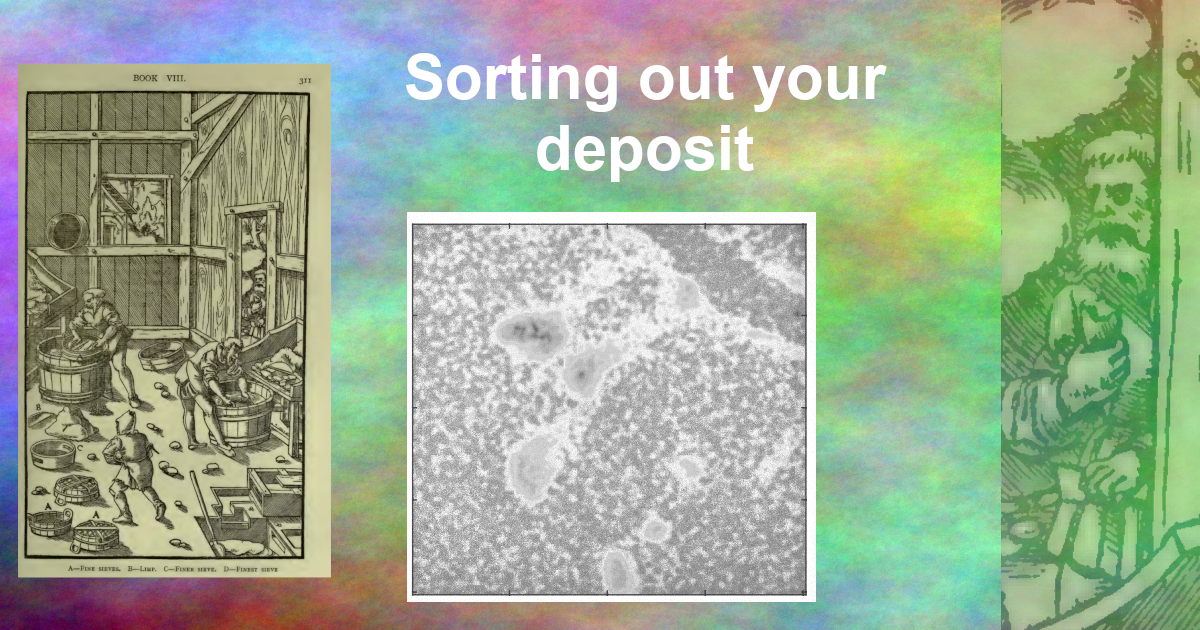
XRT data looks like an image (an x-ray!). The dark spots are denser. The image is processed and used to decide on the output.
XRF (fluorescence)

XRF uses the spectra of X-rays that are emitted from a sample when it is excited by X-rays or gamma rays. The peaks can be used to estimate geochemical compositions. XRF is slower and requires grains to be relatively dust free, because otherwise it beams the dust instead. The geochemistry is used to decide on the output.
Optical/laser (reflectance, colour)

Optical data is a photograph, although perhaps capturing unusually wavelengths of light or with a particular filter. The image is used to decide on the output. Laser technology uses the degree of scattering to separate minerals based on their opacity, as well as other characteristics. More details can be found here.
Processing XRT images
Let’s zoom in on XRT. The raw images need to be processed in some way so as to generate a 0/1, bad/good signal. Remember, this needs to happen in a fraction of a second, too.
Traditional methods use image segmentation to count the amount of dense material clusters in the grain, with the idea that those are metal. If it’s above a certain threshold it gets a 1, otherwise it gets a 0. The parameters to tune are how the image is processed and the threshold for bad vs good.

Dual energy XRT uses two emitters with different wavelengths to generate additional information. One emitter is higher energy and the other is lower, and by using the two channels the contrast is increased and allows the estimation of higher and lower atomic numbers.

Labelling images like this is a computer vision task at the end of the day, and therefore there is an opportunity to apply the wealth of techniques developed in that field. The application of machine learning, AI, whatever you want to call it, to ore sorting is a very hot topic and one with both demonstrated application and great potential for improved effectiveness. As with all machine learning, however, there is a tradeoff between efficiency and simplicity that must be evaluated for each use case.
What’s next for ore sorting?
Large scale application of ore sorting is still in its early stage, but I expect we will see the uptake increase dramatically in the future as the inputs for mining (fuel, water, ore) become more scarce and expensive. Today, from what I can see, ore sorting using XRF and XRD is still in the prototype stage. I expect that the killer app will be dealing with complex ore like in rare earth deposits where without some kind of highly sensitive, multi-channel sorting things may never work.
I think the biggest thing coming will be to combine multiple channels and submit that to a classifier or ensemble. More features could lead to more complex and effective classifiers. The challenge here is partially cost, but also developing and perfecting the training process. The system has a confusion matrix, just like any other classifier, and it needs to be as good as possible for the end goal (enriching head grade) to happen.
References
Firsching M., Spencer, R., and Leisner, J. (2024). A Study in XRT Sensor-Based Sorting for Critical Minerals and Elements, MEI Critical Minerals symposium 2024. https://www.min-eng.com/criticalminerals24/drafts/session1/firsching.pdf
Omori, T., Suzuki, S., Michibayashi, K., and Okamoto, A. (2023) Super-resolution of X-ray CT images of rock samples by sparse representation: applications to the complex texture of serpentinite, Scientific Reports, Volume 13, 6648. https://doi.org/10.1038/s41598-023-33503-6
Robben, C., Condori, P., Pinto, A., Machaca, R., and Takala, A. (2020) X-ray-transmission based ore sorting at the San Rafael tin mine, Minerals Engineering, Volume 145. https://doi.org/10.1016/j.mineng.2019.105870.