
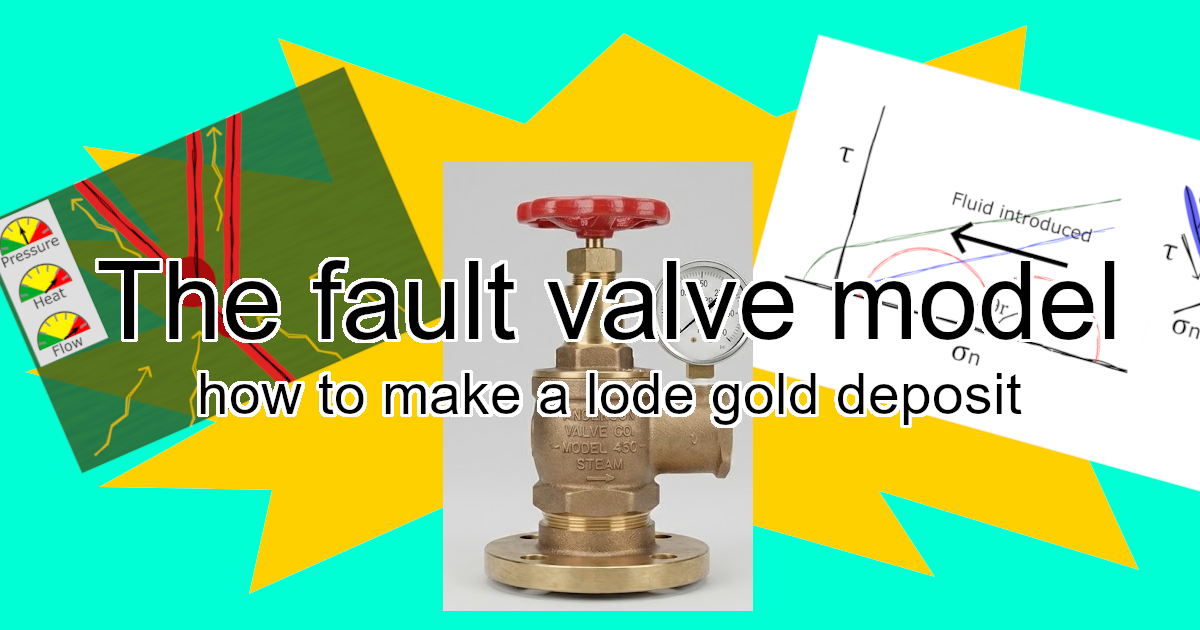
Introduction
This week I made another video with Unicorn Exploration where we talked about Archean lode gold deposits, and a little bit about how they formed. I wanted to dive in to part of the story in a lot more detail.
The idea of faults as valves and its importance to mineralizing systems was first described by Richard H. Sibson in the 1980s. It’s a critical (har har) idea in a lot of ways, both from a technical perspective and from the perspective of mineral exploration paradigms.
What is the fault valve model?
What Sibson described is a mechanism by which fluid and stress build up within a fault until it reaches a critical point and fails (Sibson, 1981; Sibson, 1990). The fluid and stress are thus released and flow into the surrounding rocks and are dissipated. He linked modern observations of massive fluid flow associated with earthquakes to the evidence for ancient high-flow events in deeper, older rocks: vein systems!
He proposed that this sudden, explosive fluid flow was the mechanism by which sufficient fluid could move through reactive rocks to create a gold +/- other elements vein (Sibson et al., 1988). And it was the aggregation of these veins, or perhaps a repeatedly activated fault valve, that together formed a mineral deposit that we would be interested. In other words, where there was sufficient concentration of otherwise rare element such as our mutual friend gold.
How it works
The idea is that faults, or more broadly zones of weakness that could become faults, are sitting in the crust and are under confining stress. They aren’t failing yet though, because the shear stress is not overcoming the normal stress and strength of the zone. The state, plotted on an example Mohr’s circle, looks like this (Trigger warning: Mohr’s circle).

Mohr’s circle review (don’t worry, I got you)
OK let’s start with the coordinate system. The inset figure in the top right shows the actual situation: a fault plane is oriented at an angle to the principal stress directions sigma 1 and 2. Based on that angle, we can use trigonometry to decompose the stress on the fault into a component parallel to the fault (shear, τ, or “tau”) and a component perpendicular to the fault (normal stress, σn or “sigma n”).
The Mohr’s circle is drawn on a coordinate system where the X axis is the stress pushing perpendicular to the plane and the Y axis is the stress pushing parallel to plane “shear”.
Then we put two points on the plot: σ1 and σ3, the actual amounts of the maximum and minimum principal stress, if they were oriented perpendicular to the fault. The shear stress is 0 in those two cases (and only those two cases). Why do we do this? So we can draw the circle. It’s a circle because of trigonometry, and the purpose of the circle is to convert the stress on the plane into shear and normal components.
One thing that has always confused me: shouldn’t the orientation where sigma 3 is perpendicular to the plane mean that sigma 1 is parallel to the plane, and therefore shouldn’t that direction have the maximum shear stress? No. Shear develops when an orthogonal direction cannot capture the whole force. Imagine a block of wood that gets cut vertically and also horizontally. You put the (now four) blocks of wood in a vice and place a heavy weight on top. How much shear is on the planes you cut? None. Both sides are being pushed down by the big weight, and both are being pushed together by the vice. Neither is moving past the other – there is no shear.
The other thing we can plot on the diagram are strength envelopes: the blue and green lines above. These are just plots of functions that express that given a normal stress (holding something together), this is the shear stress it would take to break it. The green line shows the envelope of intact rock. It can fail in tension (left of the Y axis, where normal stress is negative), or from shear (right of the Y axis, where normal stress is positive). The blue line shows the envelope of a pre-existing fault. It has no cohesion, meaning it starts with a y-intercept of 0 (because if there is nothing holding it together, it cannot resist shear stress at all).
If the circle intersects or touches the failure envelope, the rock or fault can fail. If it doesn’t, it can’t.
How to make a fault fail
Two things can happen to change the arrangement of things on the diagram. First, the amount of fluid, and thus pore pressure, can increase, which moves the state of the system to the left by effectively reducing the confining stress. When that happens, the circle can intersect the failure envelope and the fault will slip.

Another thing that can happen is deviatoric stress can increase in such a way or the angle of the fault can change so as to increase the shear stress, but without increasing the confining stress enough to compensate. The state changes, and the rock fails.

In reality, of course, these factors will co-occur. High, or more importantly, changing stress can be associated with high fluid pressure in certain situations. Sounding familiar yet?
Valves
The fault valve comes from the fact that either stress must change, or fluids must build up, before they can escape. In that way, the fault valve isn’t a normal valve, but more like a pressure relief valve. A pressure relief valve works by using an adjustable spring to push two plates together. The harder the spring pushes the plates together, the more pressure is required before fluid can escape. In the fault valve model, a valve where the spring is just open can let fluid flow through happily. Where it’s too tight, it will break the valve before it escapes. And if its just right, the fluid can buildup, escape in a big burst, build up, and maybe repeat.
Why fault failure forms gold veins
Reactive rocks like basalt, iron formation, ultramafics, etc., that have a high amount of iron in them and that can act to help bring gold out of solution, are not famously permeable. This is particularly true once they are 10 km below the Earth’s surface. So on their own, very little fluid moves through them, and if it does, it isn’t particular focused. Let’s picture the situation as below:

Fluid and heat are making their way slowly up through the rock mass. The faults are there but are pretty closed up due to the effect of the confining pressure. Fluid is under high pressure because flow is driven by external forces and the permeability is low. This situation is not going to result in a concentration of gold in any particular location, which is a problem when it comes to finding and mining it.
But what happens if the buildup of fluid causes the faults to reactivate?

That fluid wants out, and when we pop open that fault, there is a massive concentration of flow into that zone, before it closes back up (and keeps the fluid from just plain old escaping). Maybe it happens again, maybe it doesn’t. We also get a sudden pressure drop, which can lead to flash vaporization and precipitation of gold in certain settings. We might get much higher flow through or along intersections between faults, as well as extra pressure drop which could lead to richer precipitations: shoots.
A paradigm shift: how the fault-valve model led to the mineral systems approach
The fault valve model provided an elegant mechanical explanation for how lode gold deposits formed, and by extension the importance of fault geometry in localized deposits. But zooming out, what determined where lode gold deposits actually occurred? There is a huge number of faults in Archean rocks, including steeply dipping reverse faults, and almost all of them aren’t mineralized. If metamorphic devolatilization, possibly with some component of magmatic fluid or other special sauce locally, was the main source of these otherwise-normal fluids, then why weren’t gold deposits everywhere?
I believe that it was the need to answer these questions, rooted in the satisfying description of a mechanism for forming deposits, that resulted in the development of the mineral systems approach for exploration.
At the more local scale, the development of the fault valve model led geologists to look at lode gold systems more empirically and mechanically. The outcome of that line of thought was the coming-but-still-not-accepted-in-practice paradigm of viewing mineral deposits as the products of self-organized complex systems forming natural chemical reactors.
Finally, by combining the “where to find (at certain scales)” of the mineral systems approach with the “why they form” of self-organized complexity, we begin to take steps towards “where to find big deposits”. We can use the notion of a fault valve on its own to find mineral deposits, as I will show later on. But there is a good argument to be made that to find GIANT deposits, we don’t just need a pressure relief valve. We need a relief valve where the outlet is connected to the adjustment screw – a feedback loop. Feedback loops generate complexity, and complexity means big deposits.
But what do we DO with it
So the fault-valve model provides a start on how to locally understand the mechanism of gold deposition, as well as a hint for how to look for giant deposits. But does it give us any predictive power at the exploration scale? Can we use it to find gold?
The answer is yes – but we need to follow the proposal of the importance (primacy) of fault valves to its conclusions.
Thinking through the fault valve model
- there is a bunch of fluid coming from somewhere, and kind of going everywhere equally unless it gets focused.
- faults occur along planes of weakness, but if they are too weak than they will keep failing and the fluids will escape
- therefore we want planes of weakness but that are actually kind of strong, like
- faults that formed in a slightly different stress regime
- places stress regimes are locally perturbed, like along jogs in large regional faults.
- faults, particularly big faults at the edges of the system, might continue to be active, so they could look young, or even get filled in with dykes or something later as more or different fluid travels along them
- rocks are pretty much the same temperature everywhere within a reasonable property-scale of investigation as a result of the geothermal gradient
- they are under pretty much the same stress everywhere due to the weight of the overlying rocks
Where does that leave us?
- We are looking for zones of lithological and structural complexity
- They need to be oriented in such a way so as to reactivate/activate but not too easily
- Within a 50 x 50 km square the character of temperature, stress, and fluid is pretty homogenous MOST of the time
Therefore to find a localized concentration, we need to find the geometry that could create it. In part 2, I’m going to show you how much we can do using the ideas we’ve developed here.